ChatGPT workspace agents are described by OpenAI as an evolution of GPTs. Powered by Codex and running in the cloud, they can execute tasks autonomously, continue working when users are offline, and be shared across an entire organisation. The feature is currently available in research preview, with free access until 6 May 2026, after which credit-based pricing will apply.
What workspace agents can do
Workspace agents are designed to handle tasks that currently require manual coordination across teams and tools. They can write and execute code, access connected applications, retain memory across sessions, and operate on a schedule or respond to requests in real time via Slack.
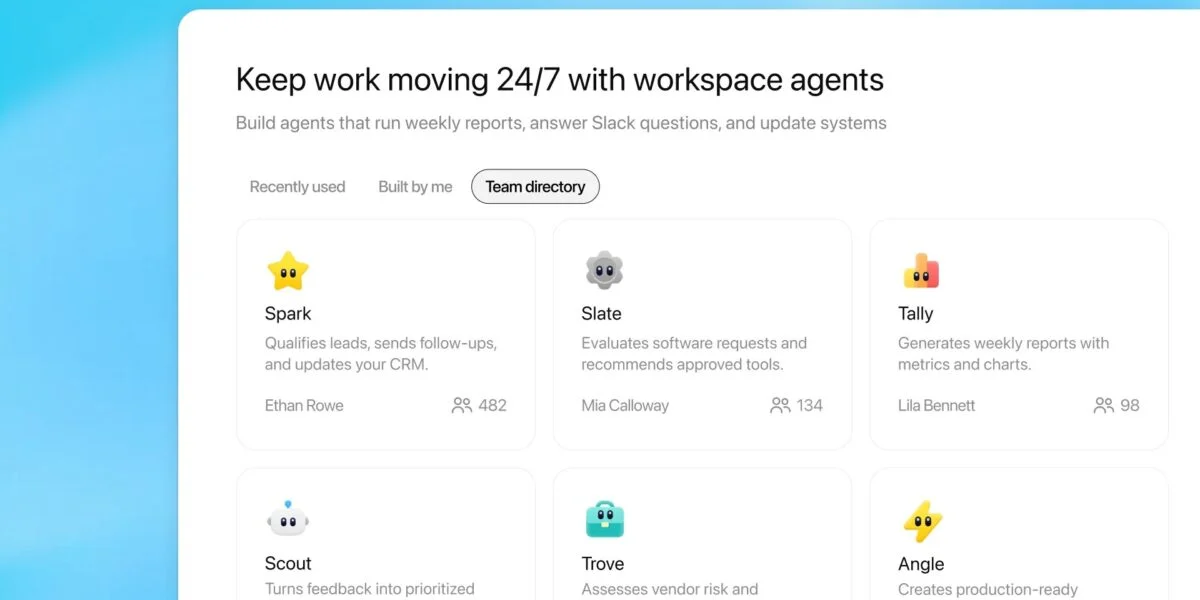
OpenAI has outlined several use cases that teams can build using the platform. A software review agent can triage employee software requests, check them against approved tools and internal policies, and file IT tickets where required. A product feedback routing agent monitors Slack channels, support queues, and public forums, then consolidates and prioritises feedback into weekly summaries. A weekly metrics reporting agent pulls data on a set schedule, generates charts, writes a narrative summary, and distributes the report to the relevant team. A lead outreach agent qualifies inbound leads, drafts personalised follow-up emails, and updates CRM records. A third-party risk management agent researches vendors for sanctions exposure, financial health, and reputational risk, producing a structured assessment report.
OpenAI’s own teams are among the early adopters. Its sales team uses an agent to compile call notes and account research, qualify leads, and draft follow-up emails. Its accounting team uses an agent to handle components of month-end close including journal entries, balance sheet reconciliations, and variance analysis..
Building and deploying agents
To create a workspace agent, users click the Agents option in the ChatGPT sidebar and describe the workflow they want to automate. ChatGPT guides the setup process by defining steps, connecting tools, adding relevant skills, and running tests. Pre-built templates are available for finance, sales, marketing, and other functions, each with built-in skills and suggested tool connections.
Once built, agents can be deployed within ChatGPT or added to Slack channels where they can respond to queries, surface relevant documentation, and file tickets for follow-up items. Additional deployment surfaces are expected to follow.
Agents support memory, meaning they can be refined through use over time. Teams can correct and guide agents in conversation, and improvements are retained for future runs.
Controls and enterprise governance
Administrators retain full control over agent permissions, including which tools and data sources an agent can access, which actions require approval before execution, and who within the organisation can build, use, and share agents. Sensitive actions such as sending emails, editing spreadsheets, or modifying calendar entries can be configured to require explicit approval before the agent proceeds.
An analytics dashboard provides visibility into each agent’s usage, including total runs and the number of active users. The Compliance API gives enterprise administrators a complete log of every agent’s configuration, updates, and run history, with the ability to suspend agents if required. Built-in safeguards are also in place to protect against prompt injection attacks when agents interact with external content.
ChatGPT Enterprise and Edu admins can additionally control which connected tools and actions are available to specific user groups through role-based access controls.
Availability and pricing
Workspace agents are available now in research preview for ChatGPT Business, Enterprise, Edu, and Teachers plans. The feature is free to use until 6 May 2026, after which credit-based pricing will apply. Enterprise and Edu admins can enable the feature for their organisations using role-based controls. Existing GPTs will remain available while teams transition, with a conversion tool to migrate GPTs into workspace agents planned for release in the near term.
For businesses across the Middle East looking to reduce manual coordination across sales, finance, operations, and customer-facing workflows, workspace agents represent a significant step forward in practical AI deployment within existing team tools.
Also Read: OpenAI launches GPT-5.4-Cyber for cybersecurity teams
Frequently asked questions
What are ChatGPT workspace agents?
Workspace agents are shared AI agents built within ChatGPT that can handle complex, multi-step workflows on behalf of teams. Powered by Codex and running in the cloud, they can execute tasks autonomously, retain memory across sessions, and continue working when users are offline.
How are workspace agents different from GPTs?
Workspace agents are an evolution of GPTs with significantly expanded capabilities. While GPTs respond to individual prompts, workspace agents can run multi-step workflows, connect to external tools and data sources, operate on a schedule, retain memory, and be shared across an entire organisation. OpenAI has confirmed that existing GPTs will remain available, with a conversion tool planned to migrate GPTs into workspace agents.
Which ChatGPT plans support workspace agents?
Workspace agents are available for ChatGPT Business, Enterprise, Edu, and Teachers plans. They are not currently available on individual consumer plans.
How much do workspace agents cost?
Workspace agents are free to use until 6 May 2026. Credit-based pricing will apply from that date onwards. Specific credit costs per agent run have not yet been published by OpenAI.
Can workspace agents be used in Slack?
Yes. Workspace agents can be deployed in Slack, where they can respond to requests in real time, answer questions, surface relevant documentation, and file tickets for follow-up items. OpenAI has indicated that additional deployment surfaces beyond ChatGPT and Slack are planned.
How do I build a workspace agent?
Click the Agents option in the ChatGPT sidebar and describe the workflow you want to automate. ChatGPT will guide the setup process step by step, including defining workflow steps, connecting tools, adding skills, and testing the agent. Pre-built templates for finance, sales, marketing, and other functions are also available as a starting point.
What controls do administrators have over workspace agents?
Administrators can control which tools and data sources agents can access, which actions require approval before execution, and who within the organisation can build, use, and share agents. The Compliance API provides a full log of every agent’s configuration, updates, and run history. Administrators can also suspend agents if required.
Are workspace agents secure?
OpenAI has built in safeguards to protect against prompt injection attacks when agents interact with external content. Enterprise and Edu administrators can additionally apply role-based access controls to limit which tools and actions are available to specific user groups.
Can workspace agents be improved over time?
Yes. Because agents retain memory, they can be corrected and refined through use. Teams can guide agents in conversation and those improvements are retained for future runs, allowing agents to become more accurate and useful as they are used more frequently.
Where can I learn more about building workspace agents?
OpenAI has published guidance through the OpenAI Academy and the ChatGPT Help Center, covering how to build, configure, and manage workspace agents for different team workflows.