
EPOMAKER HE75 V2 TMR Review: Fast, Flexible and Surprisingly Well Tuned
Our EPOMAKER HE75 V2 TMR review covers its TMR switches, Rapid Trigger, 8K polling, wireless performance, sound, software and battery life.
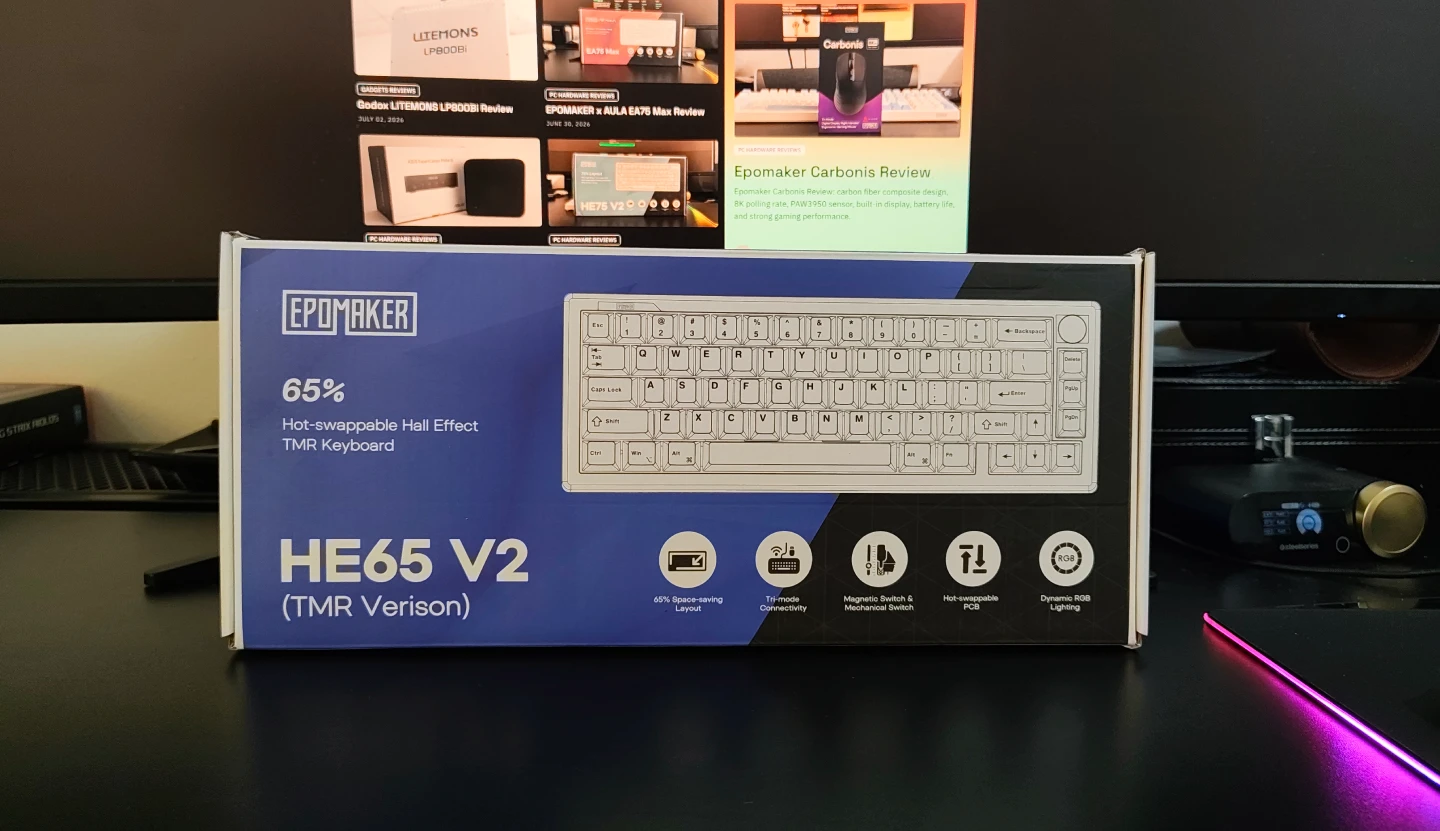
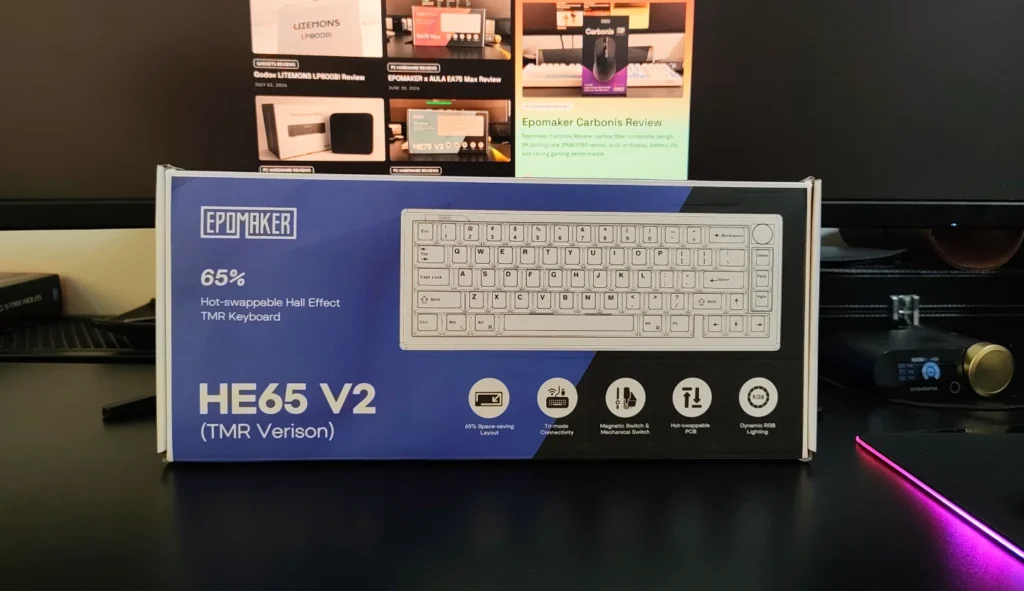
EPOMAKER has already established a sizeable range of mechanical and magnetic keyboards, and the HE65 V2 TMR takes the company’s magnetic keyboard approach into a compact 65% format.
The EPOMAKER HE65 V2 TMR gaming keyboard is built around TMR magnetic switches. It combines adjustable actuation, Rapid Trigger, 8,000Hz polling, tri-mode connectivity and a hybrid hot-swappable PCB that also supports conventional mechanical switches.
The most interesting feature is the hybrid PCB. Unlike many magnetic gaming keyboards that restrict users to magnetic switches, the HE65 V2 TMR can also accept standard 3-pin and 5-pin mechanical switches. That gives the keyboard a degree of flexibility that is unusual in this category.
At $99.99, it sits in a competitive part of the magnetic keyboard market. Its main appeal is not simply the TMR technology, but how EPOMAKER combines it with a compact layout, gasket mounting, wireless connectivity and the flexibility to use different switch types.
| Specification | Details |
|---|---|
| Layout | 65%, ANSI US QWERTY |
| Keys | 66 keys + rotary knob |
| Switches | EPOMAKER Creamy Jade Magnetic |
| Sensor | TMR magnetic sensing |
| Switch travel | 3.5 ± 0.1mm |
| Adjustable actuation | 0.1–3.5mm |
| Connectivity | USB-C, 2.4GHz, Bluetooth |
| Polling rate | Up to 8,000Hz wired/2.4GHz; 125Hz Bluetooth |
| Scan rate | 64kHz |
| Battery | 4,000mAh |
| Mounting | Gasket mount |
| Plate | FR4 |
| Case | ABS plastic |
| Keycaps | Matte transparent PC, Cherry profile |
| RGB | Per-key south-facing RGB |
| Hot-swap | Magnetic + 3/5-pin mechanical switches |
| Dimensions | 324 × 117 × 43mm |
| Weight | 745g |
| Compatibility | Windows, Mac, Android |
| Software | EPOMAKER Driver / EPOMAKER software |
| Price | $99.99 |
The HE65 V2 TMR arrives in a straightforward retail box. The packaging focuses on protecting the keyboard rather than providing an elaborate unboxing experience. Inside the box, we get the keyboard, a detachable USB-A to USB-C cable, a 2.4GHz wireless receiver, a combined keycap and switch puller, two spare switches and the documentation.
The included accessories cover everything needed to get started. The spare switches are also useful to have, particularly with a keyboard designed around magnetic switches.
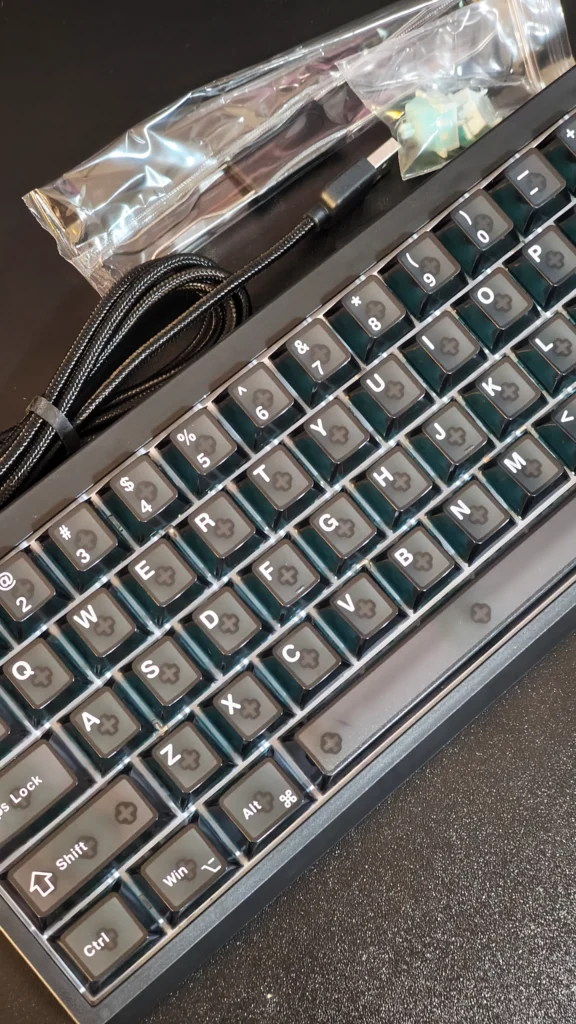
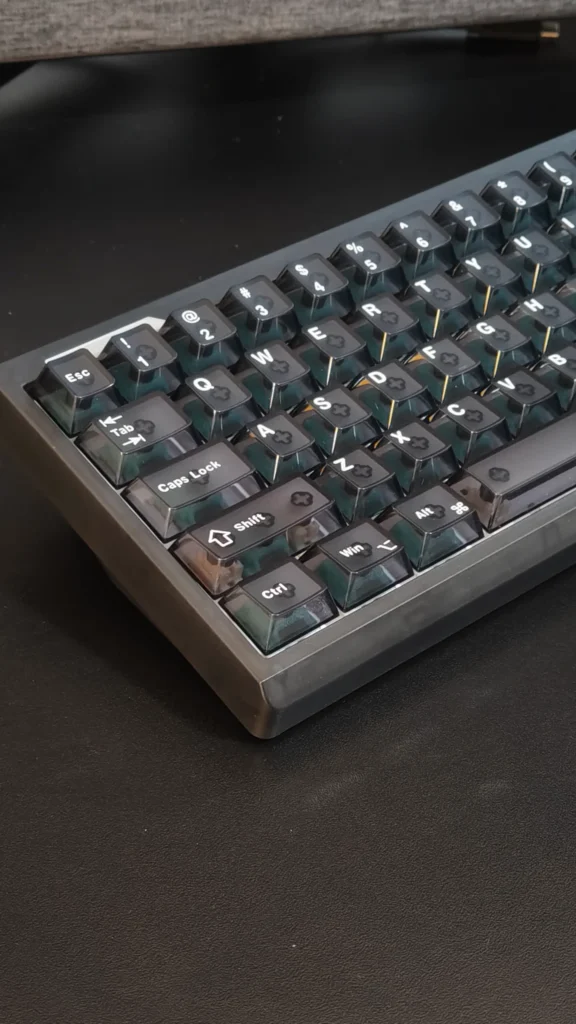
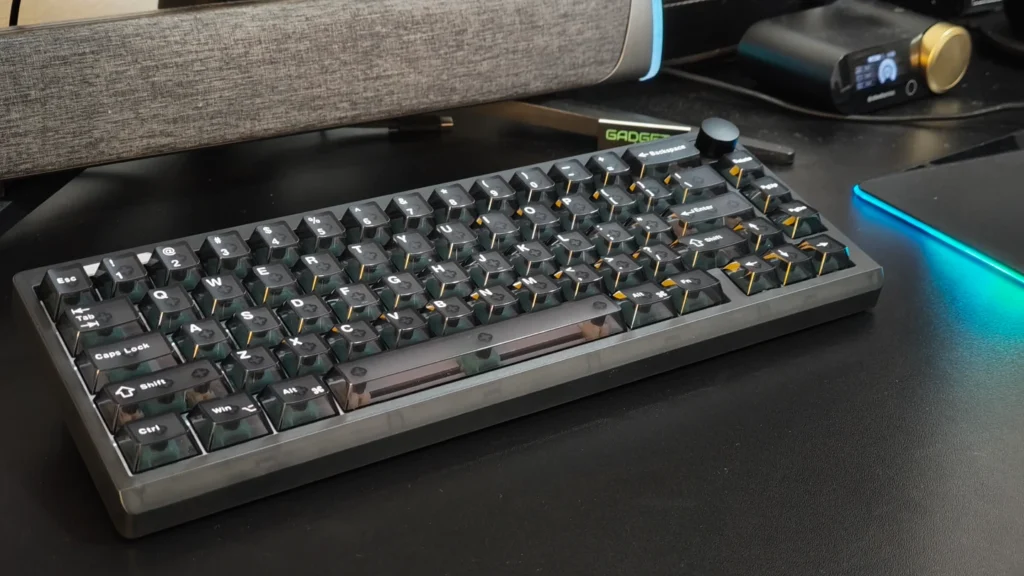
The HE65 V2 TMR uses a compact 65% layout measuring 324 × 117 × 43mm and weighing approximately 745g. The case is made from ABS plastic rather than aluminium. That immediately makes the keyboard lighter and easier to move around, although it does not provide the same solid feel as a heavier aluminium keyboard.
Our black review unit has a semi-transparent finish that gives the case a distinctive appearance. You can see portions of the internal structure through the translucent sections without the keyboard looking completely exposed.
The layout keeps the dedicated arrow keys and a small navigation cluster while removing the function row and numpad. There is also a rotary knob in the top-right corner for convenient volume control.
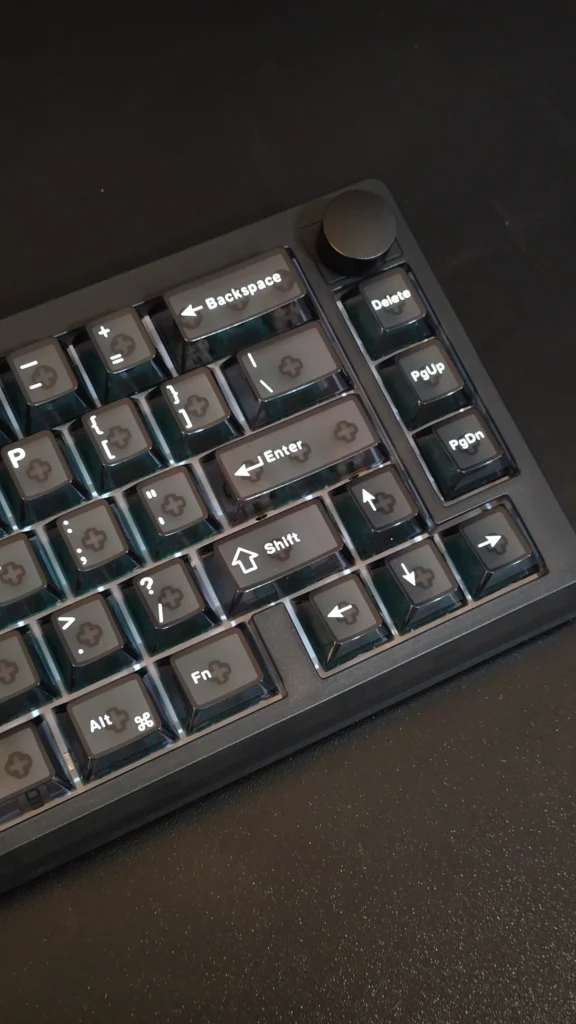
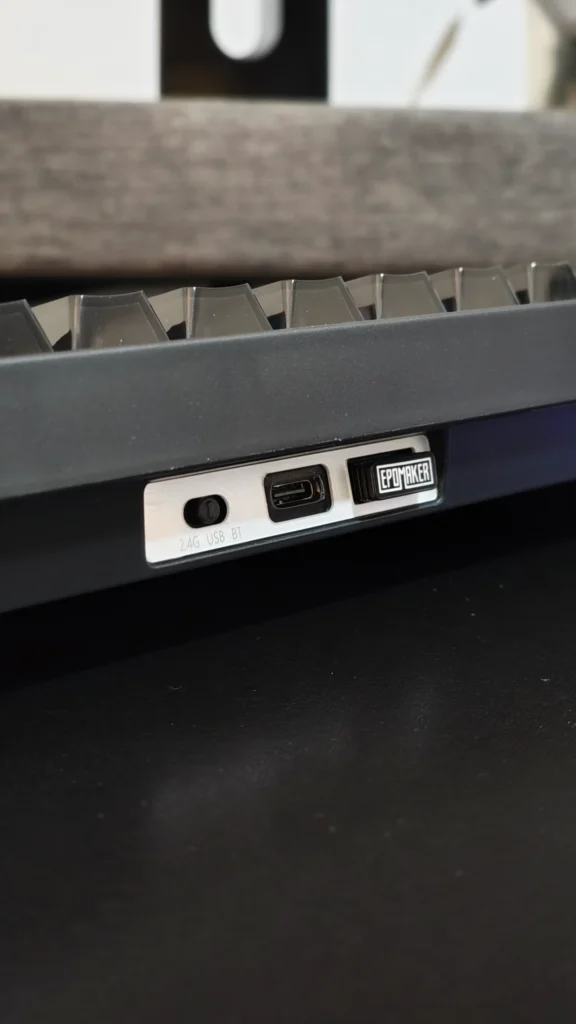
The design is relatively restrained for a gaming keyboard. There is no oversized branding or aggressive styling, so it can also fit comfortably into a regular desktop setup. The top edge houses the physical connectivity switch, USB-C port and wireless receiver storage. Having a dedicated physical switch for changing between wired, 2.4GHz and Bluetooth modes is convenient.
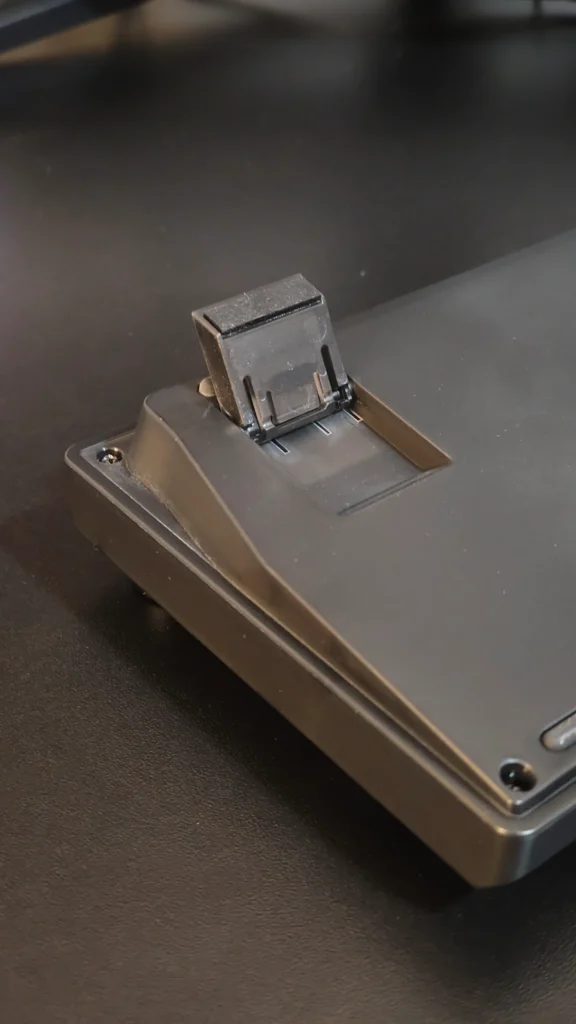
On the underside, four rubber feet help keep the keyboard stable. The two-stage kickstand provides three typing angles: approximately 6, 9.5 and 13.5 degrees. The case can flex slightly if we deliberately apply pressure, but there is little noticeable torsional movement during normal use. For a lightweight ABS keyboard, the overall construction feels sufficiently rigid.
The 65% layout is one of the strongest aspects of the HE65 V2 TMR for users who want to save desk space without moving all the way down to a 60% keyboard.
There are 66 keys, along with the rotary knob. The dedicated arrow keys remain in the familiar inverted-T arrangement, while Delete, Page Up and Page Down sit in the navigation area. There is no dedicated function row or numpad, so users coming from a full-size keyboard will need to rely on the Fn layer for some functions.
The rotary knob is useful for volume control and can also be configured through the software. It is not hot-swappable, but that is unlikely to be a major concern for most users.
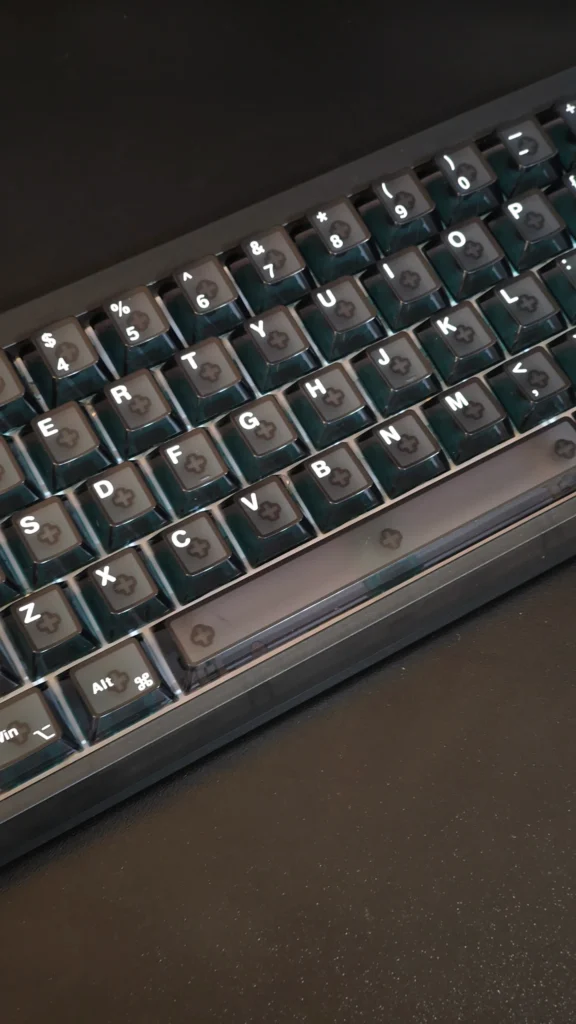
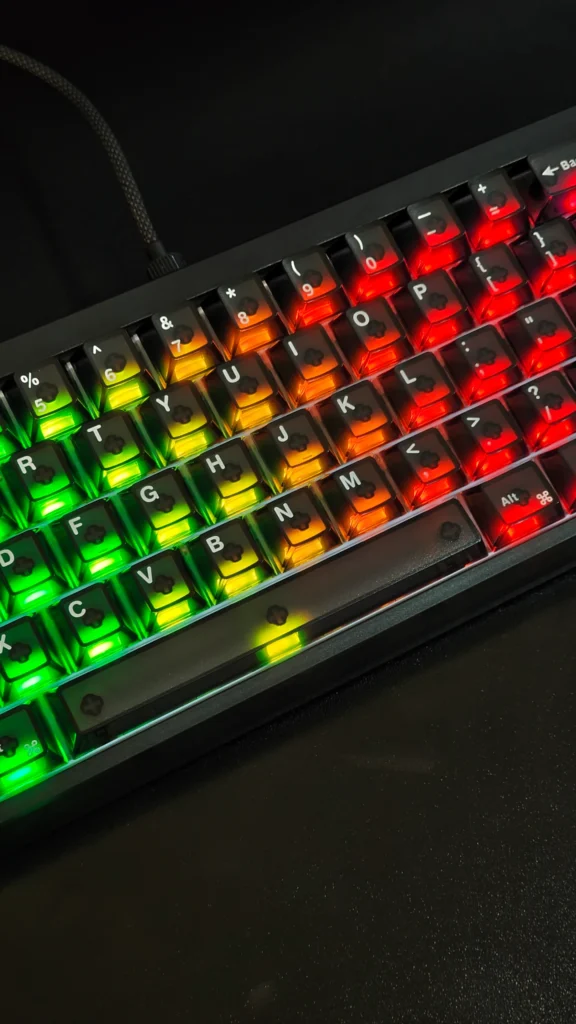
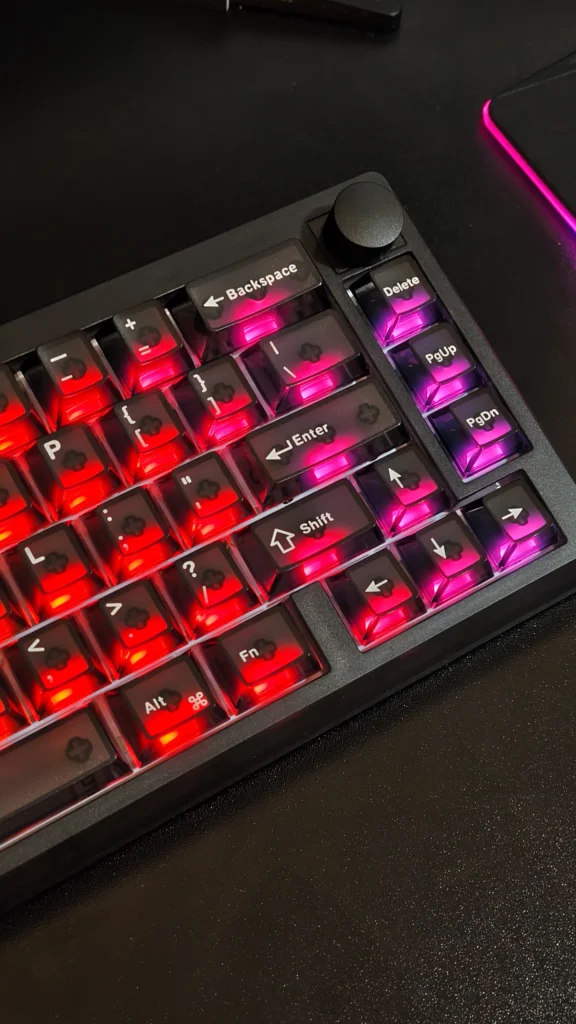
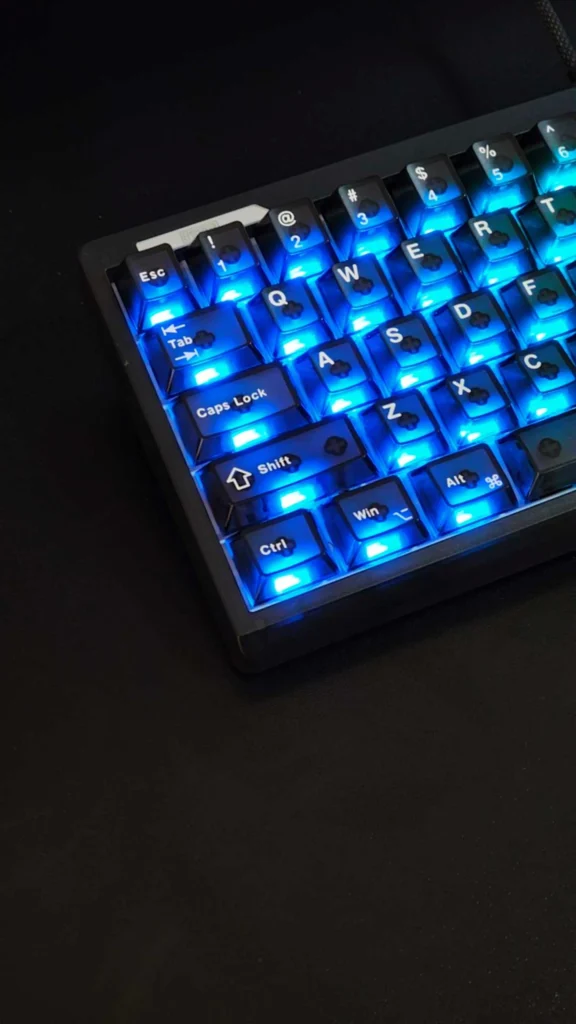
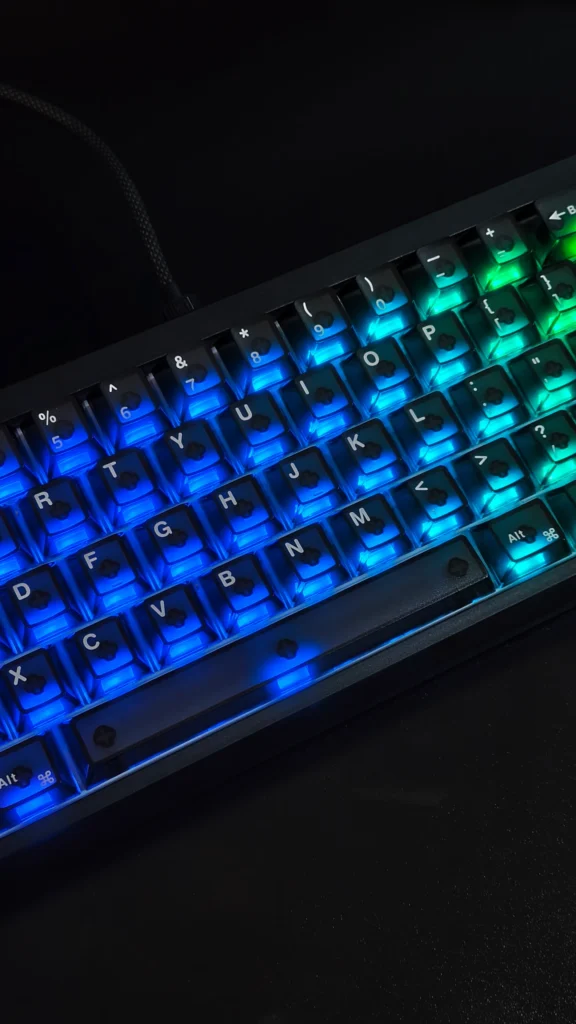
The keyboard uses Cherry-profile matte transparent PC keycaps with silk-printed legends. The translucent construction lets some of the internal components remain visible while also allowing the RGB lighting to spread through the keycaps. The surface is relatively smooth compared with textured PBT keycaps. We generally prefer a little more texture for long typing sessions, but the keycaps remain comfortable during everyday use.
The legends are clear and readable with the RGB turned off. However, they are not shine-through legends. This means the RGB illuminates the surrounding transparent material rather than the characters themselves. The keyboard uses per-key south-facing RGB lighting, with adjustable effects available through the software. The translucent keycaps make the lighting particularly visible, especially in a darker environment.
The biggest feature here is the TMR implementation. TMR, or Tunnel Magnetoresistance, is another approach to magnetic sensing. Instead of relying on conventional mechanical contacts, the keyboard detects changes in the magnetic field as the switch moves.
The HE65 V2 TMR comes with EPOMAKER Creamy Jade Magnetic switches. They are linear switches with an adjustable pre-travel range of 0.1 to 3.5mm and approximately 3.5mm of total travel. EPOMAKER lists the trigger force at 30gf minimum and bottom-out force at 55gf maximum.
In practical use, the switches feel smooth and relatively light at the beginning of the stroke before becoming progressively firmer. The factory lubrication also helps keep the movement consistent. The important point is that the TMR technology is not something we expect every user to immediately feel compared with a good Hall Effect keyboard. The bigger benefit comes from the features enabled by the magnetic sensing system, particularly adjustable actuation and Rapid Trigger.
This is arguably more interesting than the TMR branding itself. The HE65 V2 TMR uses a hybrid hot-swappable PCB that supports both magnetic switches and standard 3-pin or 5-pin mechanical switches. That means the keyboard does not have to remain a dedicated magnetic gaming keyboard throughout its life.
For gaming, the supplied Creamy Jade Magnetic switches provide access to adjustable actuation and Rapid Trigger. For users who prefer a more traditional mechanical typing experience, compatible mechanical switches can be installed instead. This gives the keyboard considerably more flexibility than a conventional Hall Effect board that only accepts its own type of magnetic switch.
The HE65 V2 TMR uses a gasket-mounted structure with a multi-layer internal sound-dampening system. EPOMAKER lists an IXPE switch pad, bottom foam and silicone material as part of the acoustic configuration, along with the gasket structure.
There is some movement beneath the keys, although it is not an especially soft or flexible keyboard. The typing experience remains relatively firm and controlled. The Creamy Jade Magnetic switches work well for both gaming and general typing. They have enough travel to avoid feeling excessively short, while the adjustable actuation allows users to configure the point at which a key registers.
The stabilizers are plate-mounted. Larger keys have a slightly different feel and sound from the smaller keys, as expected, but we did not notice excessive wobble during normal use. The stock sound is another strong point. The combination of the switches, gasket mount and internal dampening produces a relatively deep and controlled sound without excessive hollow resonance.
Users who enjoy keyboard tuning can experiment with the internal configuration, but the stock setup is already reasonably well balanced.
This is where the HE65 V2 TMR makes the most sense. The TMR sensors allow the keyboard to track switch movement and provide features such as adjustable actuation and Rapid Trigger. The keyboard supports polling rates of up to 8,000Hz over both wired USB and 2.4GHz wireless, while Bluetooth is limited to 125Hz. EPOMAKER also specifies a 64kHz scan rate.
The adjustable actuation is particularly useful for gaming. Movement keys can be configured to register earlier, while other keys can be set deeper depending on personal preference. Rapid Trigger is more relevant to competitive games. Rather than relying on a conventional fixed reset point, the keyboard can respond to changes in key movement, allowing faster repeated inputs.
EPOMAKER specifies 0.125ms latency for wired and 2.4GHz connections, compared with 14ms over Bluetooth. In practice, 2.4GHz is the mode we would use for gaming when wireless connectivity is preferred. Bluetooth makes more sense for general productivity and devices where low latency is less important.
The HE65 V2 TMR also supports additional advanced input functions such as Dynamic Keystrokes and SOCD through its software. These are features aimed primarily at gamers who want to fine-tune their controls.
The keyboard offers three connection methods:
The tri-mode configuration makes the HE65 V2 TMR suitable for both desktop and mobile setups.
We primarily used 2.4GHz for gaming because it provides the high polling rate without requiring a cable. The connection remained stable during testing.
Bluetooth is useful when connecting to devices such as laptops and tablets. It also provides the lowest polling rate and therefore is not the connection we would choose for competitive gaming.
The HE65 V2 TMR uses a 4,000mAh battery made up of two 2,000mAh cells. Battery life depends heavily on how the keyboard is configured. RGB lighting, wireless polling rate and other settings all affect power consumption.
For regular typing with moderate lighting, the battery capacity is sufficient for a few days of normal wireless use. However, users who keep RGB lighting at high brightness while running 8,000Hz polling should expect shorter runtime. The keyboard also includes a battery indicator that can be checked through the Fn layer. Power-saving settings can further reduce unnecessary battery drain when the keyboard is idle.
For everyday wireless use, Bluetooth is the more sensible option when maximum battery efficiency is the priority. For gaming, 2.4GHz provides the better balance between wireless convenience and performance.
EPOMAKER provides software for configuring the HE65 V2 TMR, including key remapping, macros, lighting controls and magnetic switch settings. The software gives users access to the features that make the keyboard different from a conventional mechanical board. Actuation points can be adjusted, Rapid Trigger can be configured and additional gaming functions can be assigned. Polling rate, RGB effects, power settings and key assignments can also be changed.
There is a lot to explore, and that is both an advantage and a minor drawback. Users who are new to magnetic keyboards may need some time to understand what each setting does and how different actuation and Rapid Trigger configurations affect their games. The software is therefore more suited to users who want to customise their keyboard rather than those who simply want to plug it in and start typing.
The EPOMAKER HE65 V2 TMR is a well-rounded compact gaming keyboard that combines several useful features into a relatively small package.
The TMR sensors are certainly an important part of the keyboard, but they are not the only reason to consider it. The combination of adjustable actuation, Rapid Trigger, 8,000Hz polling, tri-mode connectivity and a hybrid PCB gives the HE65 V2 TMR a broader feature set than its compact size suggests.
The hybrid hot-swap support is particularly useful. Being able to move between magnetic and conventional mechanical switches means the keyboard can serve different purposes without requiring another board.
We also found the stock typing experience satisfying. The Creamy Jade Magnetic switches are smooth, while the gasket-mounted construction and internal dampening keep the sound controlled without making the keyboard feel overly soft.
The ABS case is the main compromise. It keeps the keyboard lightweight, but users looking for a premium metal chassis will find the construction less substantial.
At $99.99, the HE65 V2 TMR is positioned for buyers who specifically want magnetic gaming features rather than simply a compact mechanical keyboard. For that audience, it offers a strong combination of performance, flexibility and everyday usability.

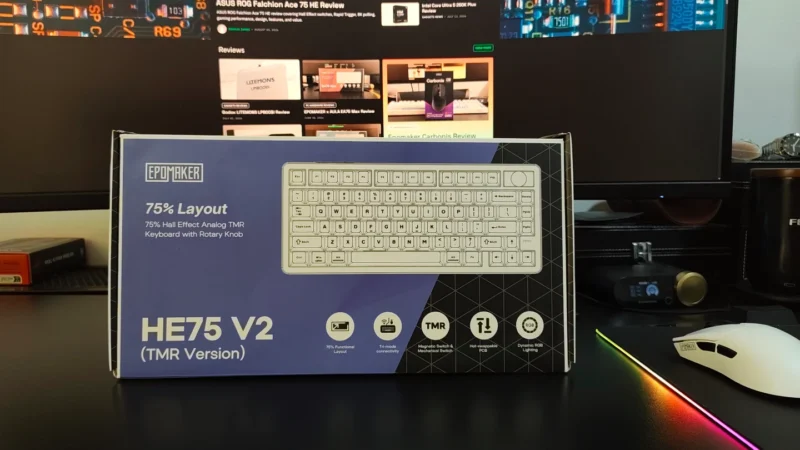
Our EPOMAKER HE75 V2 TMR review covers its TMR switches, Rapid Trigger, 8K polling, wireless performance, sound, software and battery life.
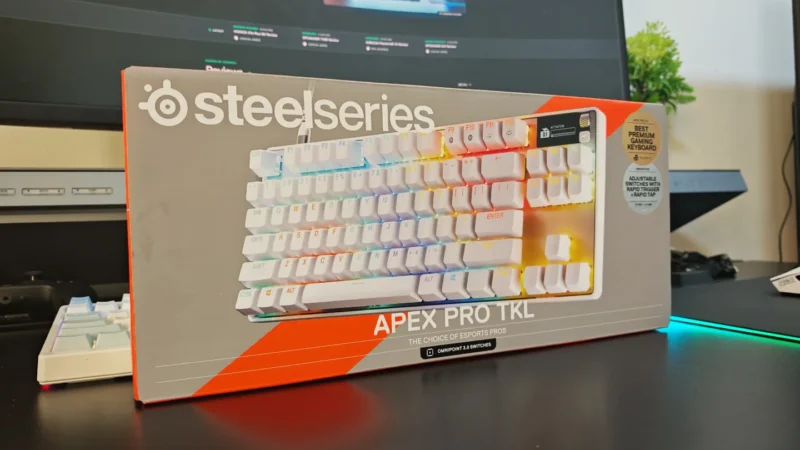
We review the SteelSeries Apex Pro TKL Gen 3, featuring OmniPoint 3.0 Hall Effect switches, adjustable actuation, Rapid Trigger, OLED display and RGB lighting.
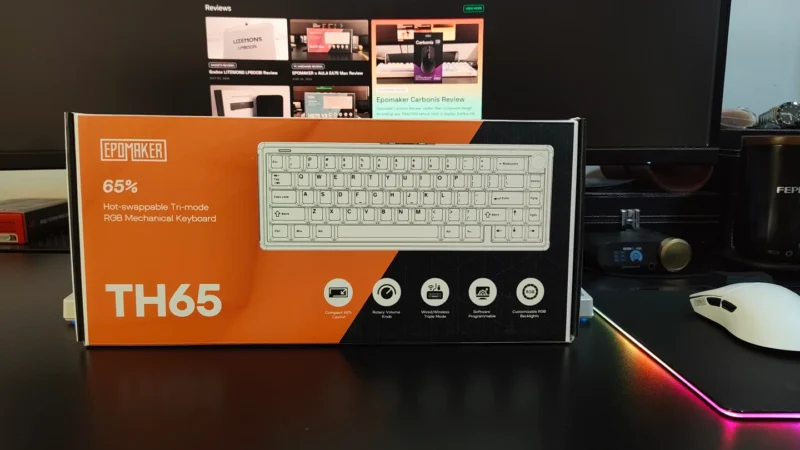
Our EPOMAKER TH65 review examines its 65% layout, Creamy Jade switches, gasket mount, 8000mAh battery, wireless connectivity, gaming performance, and value.
 Joshua James