
SteelSeries Apex Pro TKL Gen 3 Review
We review the SteelSeries Apex Pro TKL Gen 3, featuring OmniPoint 3.0 Hall Effect switches, adjustable actuation, Rapid Trigger, OLED display and RGB lighting.
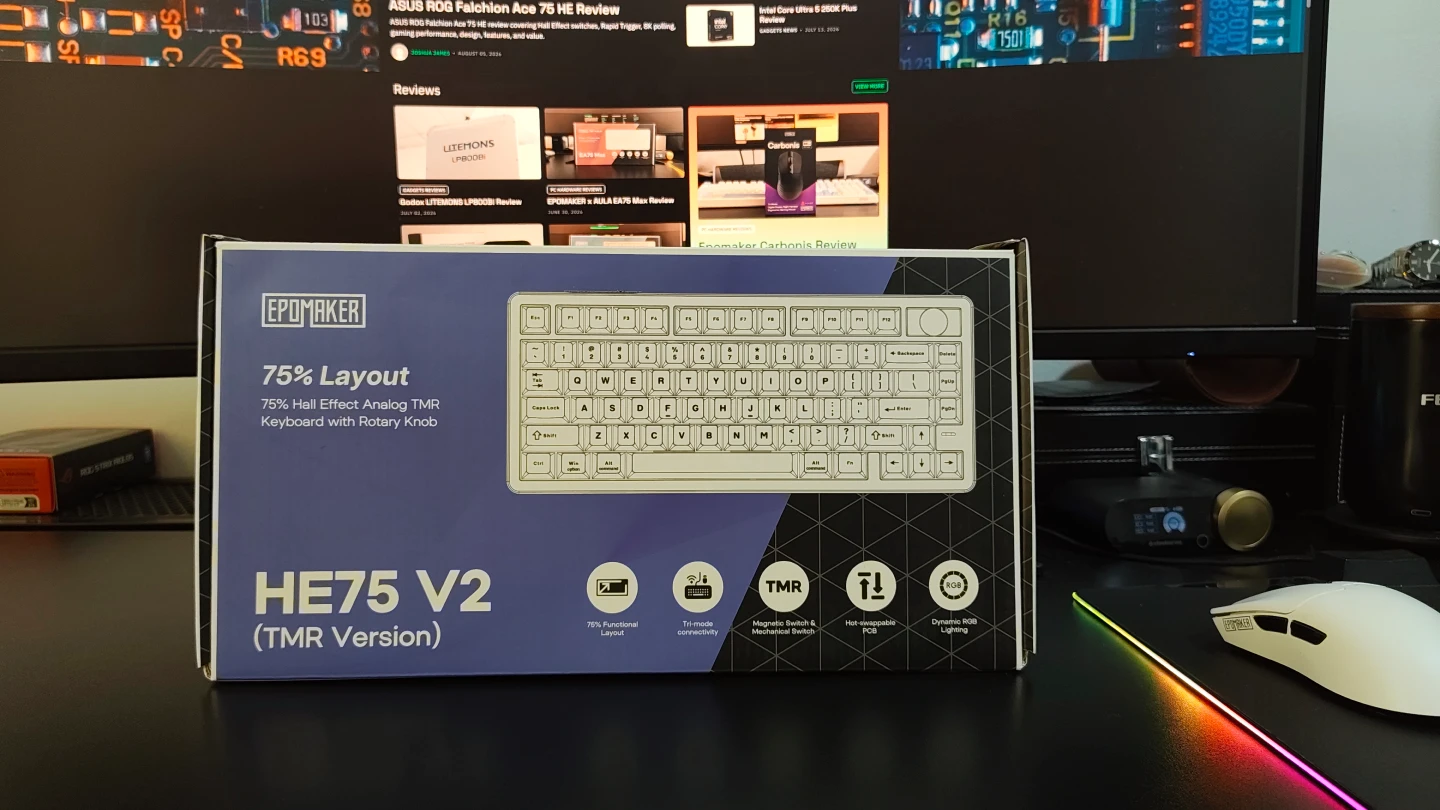
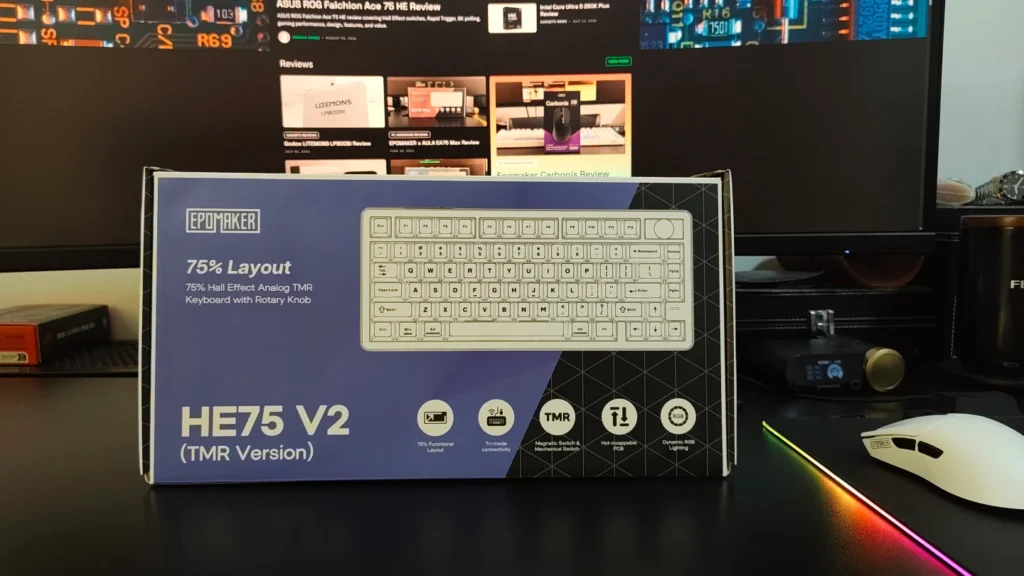
The EPOMAKER HE75 V2 TMR is a 75% gaming keyboard built around TMR magnetic sensing, adjustable actuation, rapid trigger and high polling rates. It also adds something that is still relatively uncommon among performance-focused magnetic keyboards: support for both magnetic and conventional 3/5-pin mechanical switches.
On paper, the HE75 V2 TMR covers almost every feature expected from a modern gaming keyboard. It supports 8,000Hz polling over USB and 2.4GHz wireless, offers adjustable actuation down to 0.1mm, includes an 8,000mAh battery and uses a gasket-mounted construction with five layers of sound treatment. EPOMAKER currently lists the keyboard at $129.
After spending time using it for gaming and everyday typing, we found that the HE75 V2 TMR is more than a specification-heavy gaming keyboard. Its combination of smooth switches, good acoustics, wireless connectivity and switch flexibility makes it useful outside competitive gaming as well.
There are some software and firmware quirks to consider, however, particularly if you intend to use Rapid Trigger alongside the keyboard’s advanced gaming functions.
The HE75 V2 TMR uses a hybrid PCB that supports both magnetic and 3/5-pin mechanical switches. EPOMAKER also specifies three connectivity modes, an 8,000mAh battery, 8,000Hz polling in wired and 2.4GHz modes and a 128KHz scan rate.
| Specification | EPOMAKER HE75 V2 TMR |
|---|---|
| Layout | 75%, ANSI US |
| Keys | 80 keys + swappable knob |
| Switches | EPOMAKER Creamy Jade Magnetic |
| Switch support | Magnetic and 3/5-pin mechanical |
| Actuation | 0.1mm–3.5mm |
| Polling rate | 8,000Hz wired / 2.4GHz |
| Bluetooth polling | 125Hz |
| Scan rate | 128KHz |
| Connectivity | USB-C, 2.4GHz, Bluetooth |
| Battery | 8,000mAh |
| Case | ABS plastic |
| Plate | FR4 |
| Mount | Gasket |
| Keycaps | Matte transparent PC, Cherry profile |
| RGB | Per-key RGB + front/side lighting |
| Compatibility | Windows, macOS and Android |
| Dimensions | Approximately 324 × 138 × 43mm |
| Weight | Approximately 0.98kg |
The HE75 V2 TMR uses a compact 75% layout that keeps the arrow keys, function row and navigation keys while removing the numeric keypad. It is available in black and white, with our review unit using the white finish.
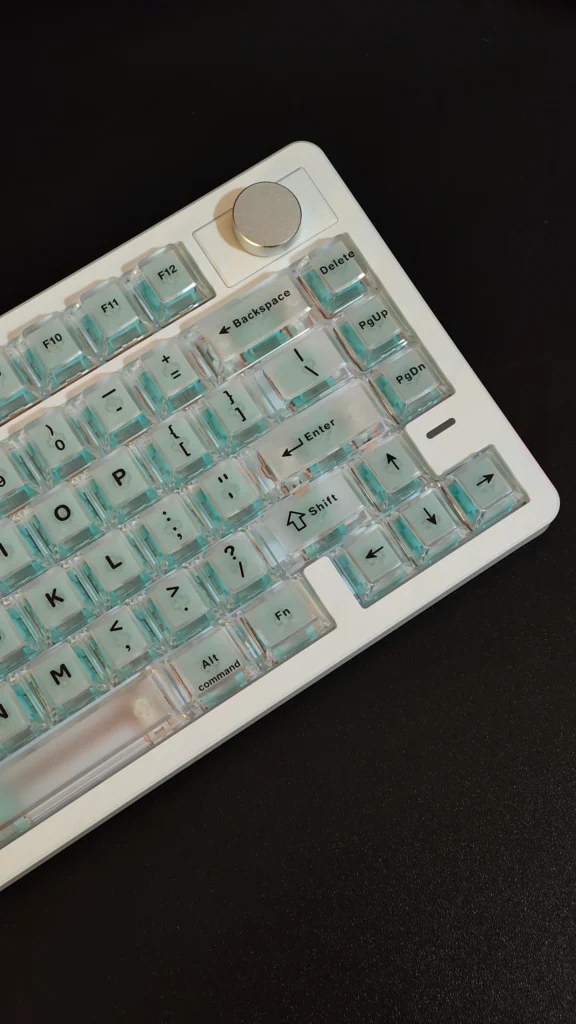
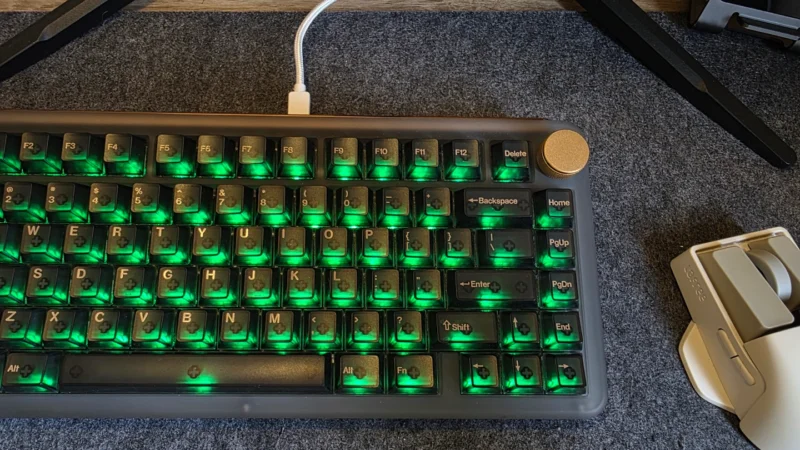
The overall design is relatively clean, but EPOMAKER has added some visual detail around the edges. The translucent, crystal-like sections along the rear and sides allow the RGB lighting to shine through without making the keyboard look excessively aggressive.
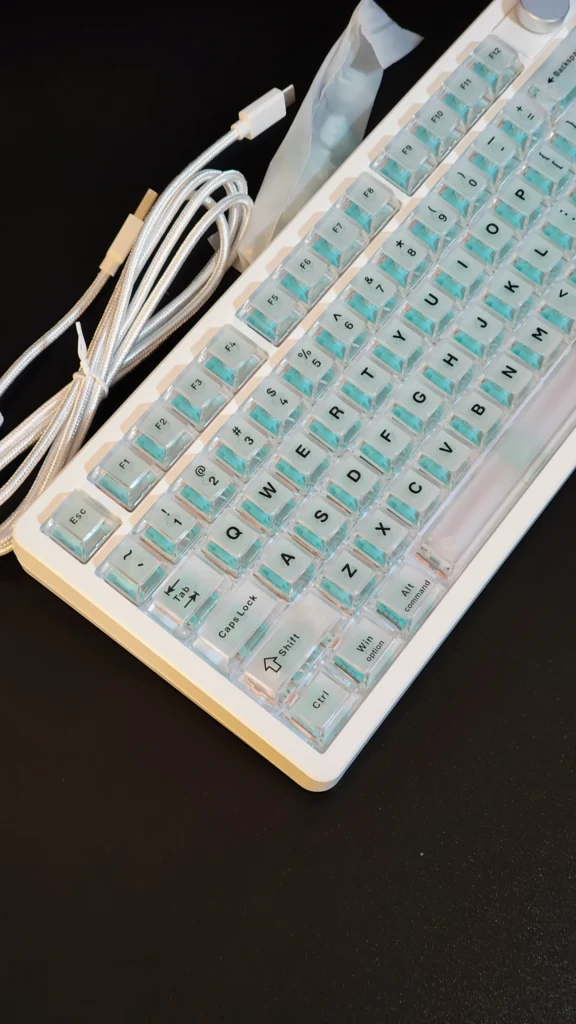
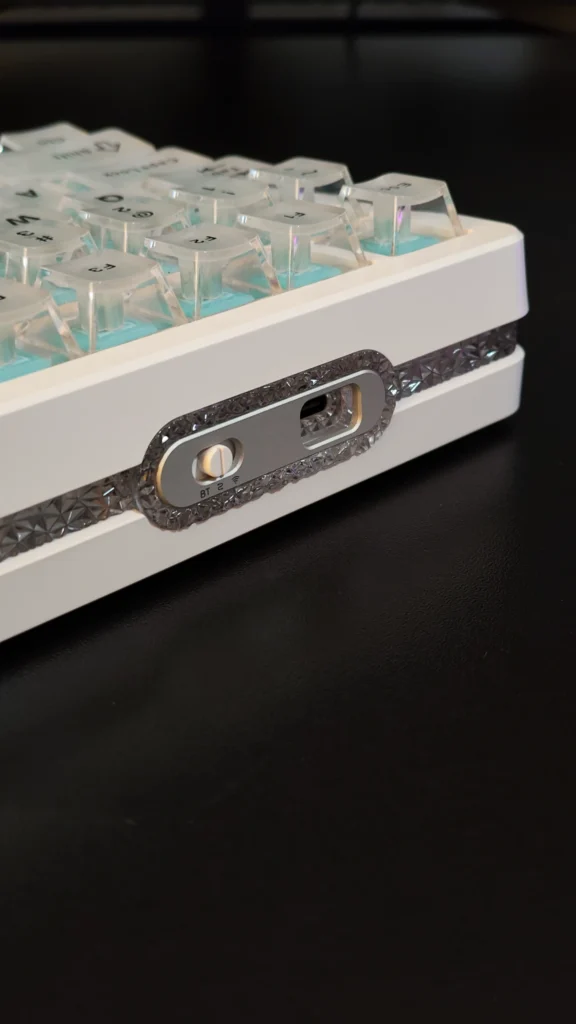
The case itself is ABS plastic rather than aluminium. That is worth mentioning at this price, but the keyboard does not feel cheap. At roughly 1kg, it has enough weight to remain stable on a desk, and there is very little unwanted movement during normal use. EPOMAKER lists the official weight at approximately 0.98kg.
The keyboard also has two-stage adjustable feet, providing three typing angles of approximately 5.8, 9 and 12 degrees. This gives users some flexibility in finding a comfortable position for gaming or longer typing sessions.
One of the more interesting design choices is the removable control knob in the top-right corner. Out of the box, it functions as a volume control, including a press action for muting. However, EPOMAKER includes replacement keycaps that allow the knob area to be converted into two conventional keys.
The knob can be removed, but some care is required. We would avoid repeatedly pulling it out unnecessarily, as the connector pins are relatively easy to bend if the module is removed at an angle. This is a useful option for users who prefer dedicated keys instead of a volume dial.
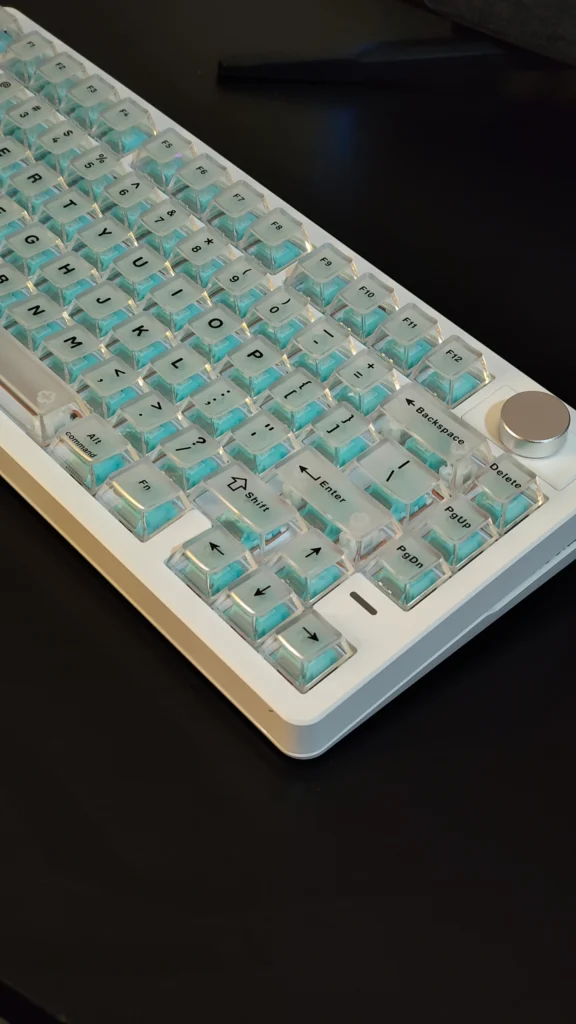
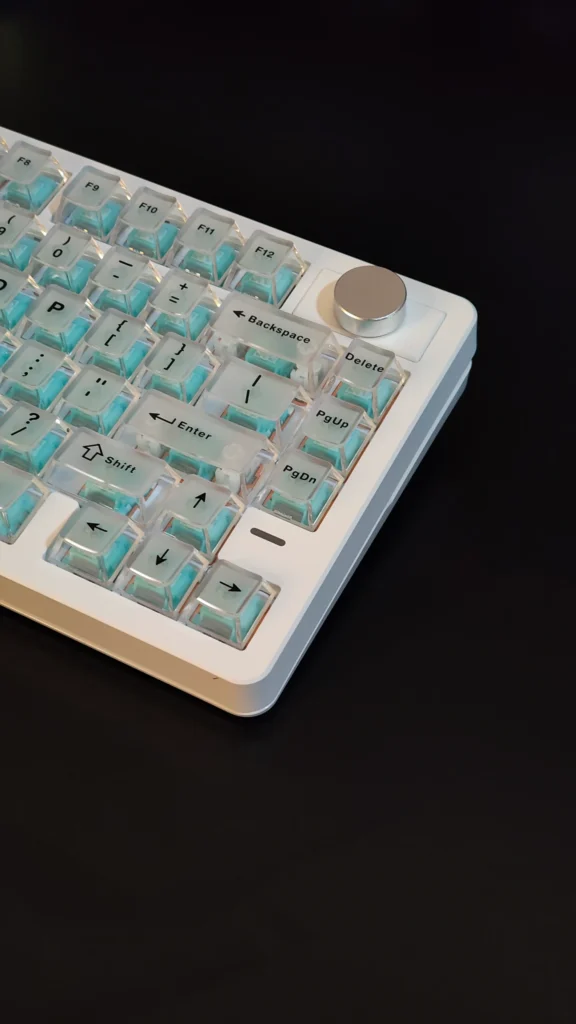
The HE75 V2 TMR comes with matte transparent PC keycaps using a Cherry-style profile. The frosted finish is particularly effective with the RGB lighting because it diffuses the light rather than allowing it to shine through as a harsh point source.
The legends are also clearly visible, while the transparent material lets the lighting become part of the keyboard’s overall appearance. The RGB implementation is one of the stronger visual aspects of the keyboard. There is per-key south-facing RGB as well as additional lighting around the exterior of the board. The light-coloured internal structure also helps reflect the illumination across the keyboard.
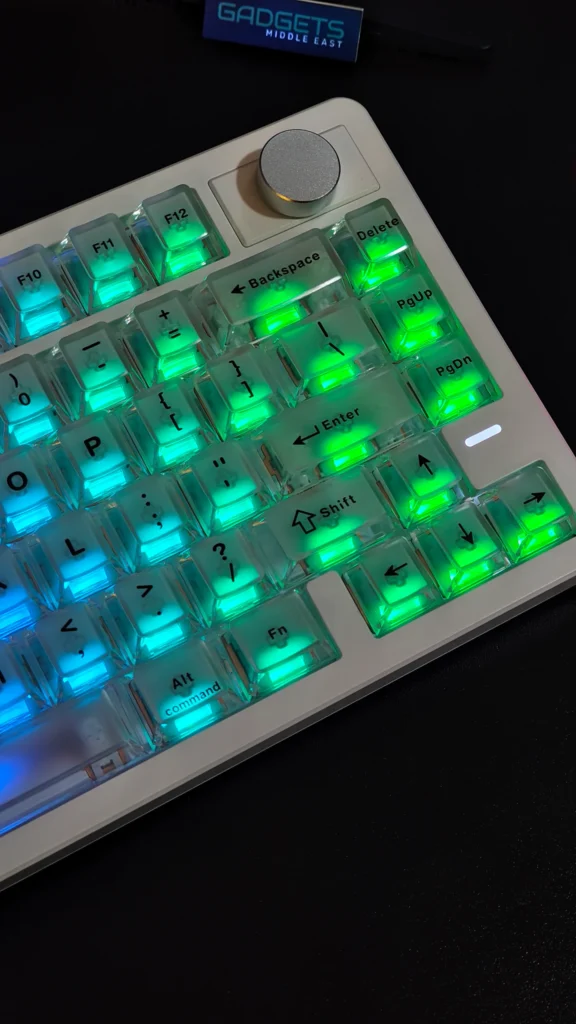
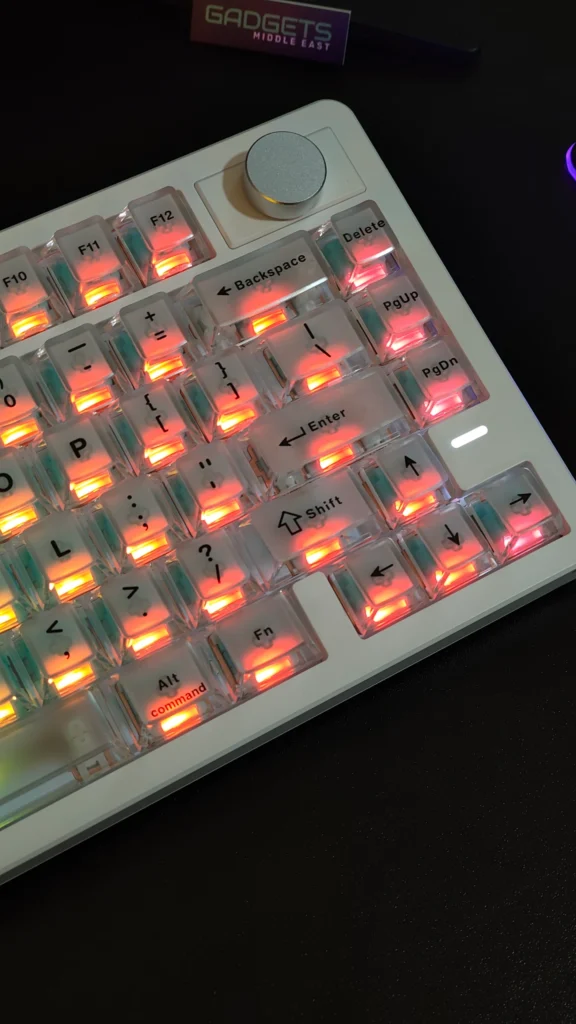
The rear and side lighting gives the HE75 V2 TMR a distinctive appearance without requiring an overly elaborate case design. EPOMAKER confirms that the keyboard supports dynamic per-key RGB and adjustable front lighting.
The HE75 V2 TMR comes with EPOMAKER’s Creamy Jade magnetic switches. They are factory lubricated and have a smooth linear feel. During everyday use, the switches felt consistent with minimal wobble. The larger keys were also stable, with the stabilisers producing very little unwanted rattle.
The switches have a 30gf initial force and up to 55gf bottom-out force, while total travel is approximately 3.5mm. Actuation can be adjusted between 0.1mm and 3.5mm. The smoothness is noticeable during both typing and gaming. Rather than feeling like a conventional mechanical switch with a fixed actuation point, the HE75 V2 TMR gives considerably more control over how the key responds.
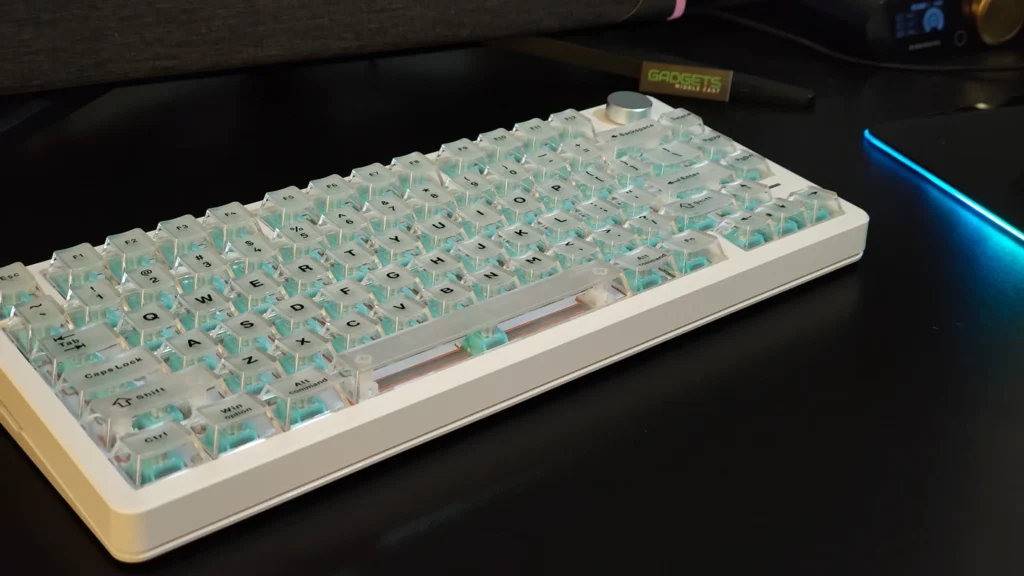
This is where the TMR version becomes particularly interesting. The hybrid PCB supports compatible magnetic switches as well as standard 3-pin and 5-pin mechanical switches. That means users are not restricted to the stock Creamy Jade switches or another magnetic switch compatible with the board.
We tested mechanical switches in the keyboard and found that they worked as expected. This also opens up more possibilities for tuning the sound and feel of the board. For example, users could keep magnetic switches on frequently used gaming keys while installing conventional mechanical switches elsewhere for a different typing feel.
It is important to note that the standard HE75 V2 and HE75 V2 TMR are not identical in this respect. EPOMAKER specifically identifies the TMR model as the version with support for both magnetic and mechanical switches.
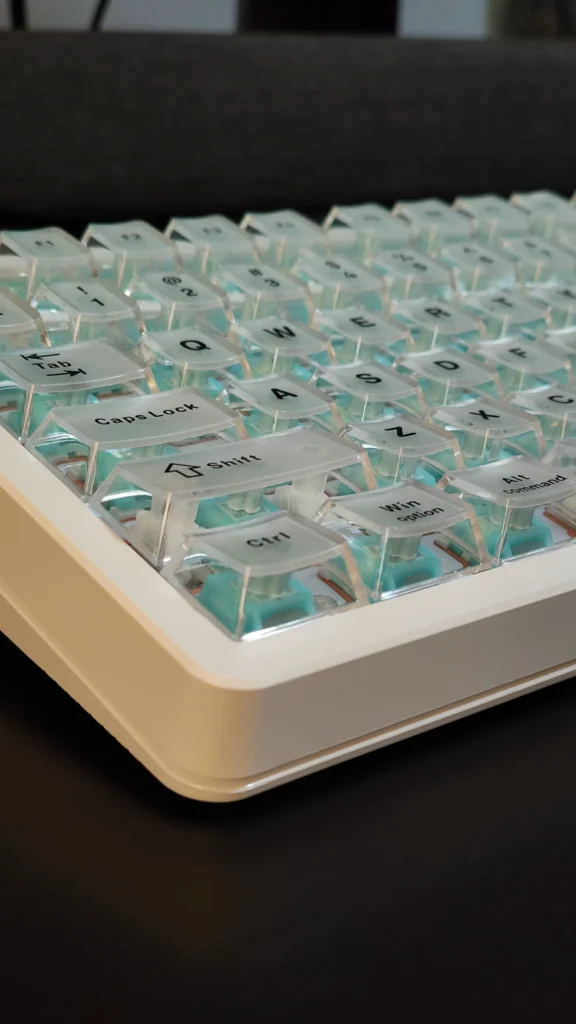
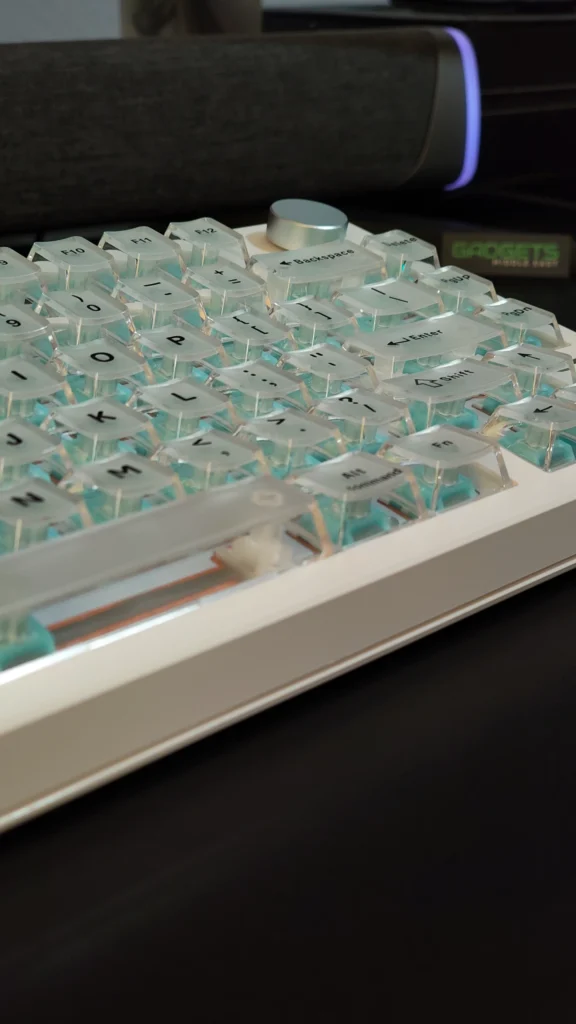
The HE75 V2 TMR is not simply a gaming keyboard that happens to sound reasonable. EPOMAKER has put considerable attention into the acoustic side of the design.
The board uses a gasket mount and a five-layer sound treatment system consisting of multiple dampening and sound-enhancement layers. It also uses an FR4 plate rather than a metal plate. In practice, this produces a smooth and relatively controlled sound profile.
The Creamy Jade switches have a soft, creamy character, while the transparent PC keycaps add their own acoustic character. The result is deeper and more controlled than the sharp, hollow sound we often associate with inexpensive gaming keyboards. The stabilisers also perform well. Larger keys such as the space bar and shift keys feel stable, and we did not encounter significant rattling during normal use.
This is one of the areas where the HE75 V2 TMR feels more like an enthusiast keyboard than a conventional gaming peripheral.
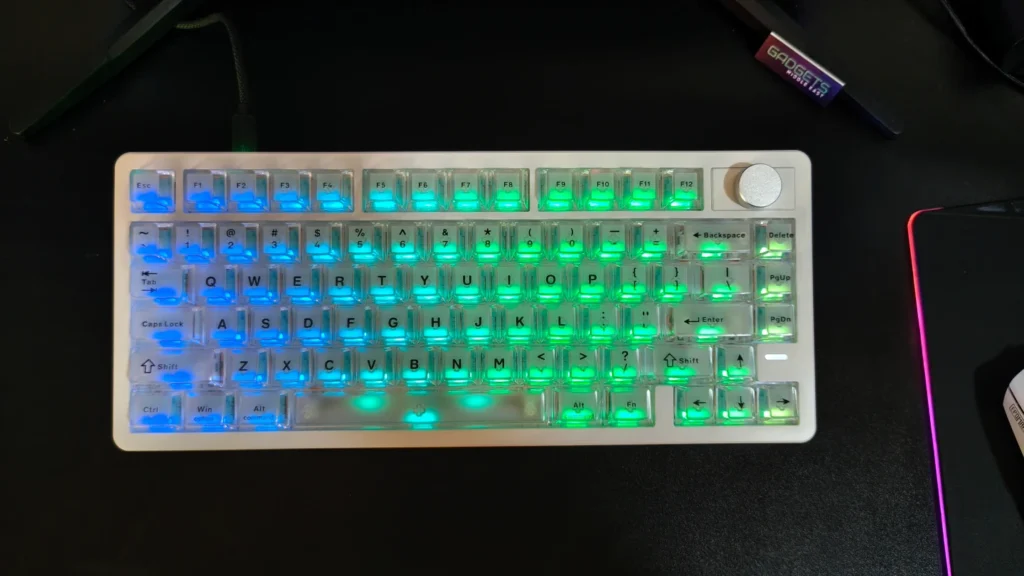
TMR, or tunnelling magnetoresistance, is a magnetic sensing technology that measures changes in electrical resistance as the magnet within the switch moves. The practical benefit for a gaming keyboard is not simply the name of the sensor technology. What matters is how accurately and consistently the keyboard interprets key movement.
The HE75 V2 TMR allows actuation to be configured as low as 0.1mm, with adjustments available in very small increments. Rapid Trigger can also respond to small changes in key travel. EPOMAKER specifies 0.01mm precision adjustment for the TMR system.
For competitive FPS games, the ability to customise actuation is useful. Movement keys can be configured to respond extremely early, while other keys can use a deeper actuation point for greater protection against accidental presses. With aggressive settings applied to movement keys, the keyboard remained responsive without producing obvious unwanted activations during normal gaming. The difference becomes particularly noticeable when rapidly changing directions or repeatedly tapping a key. The keyboard reacts quickly to both pressing and releasing the switch.
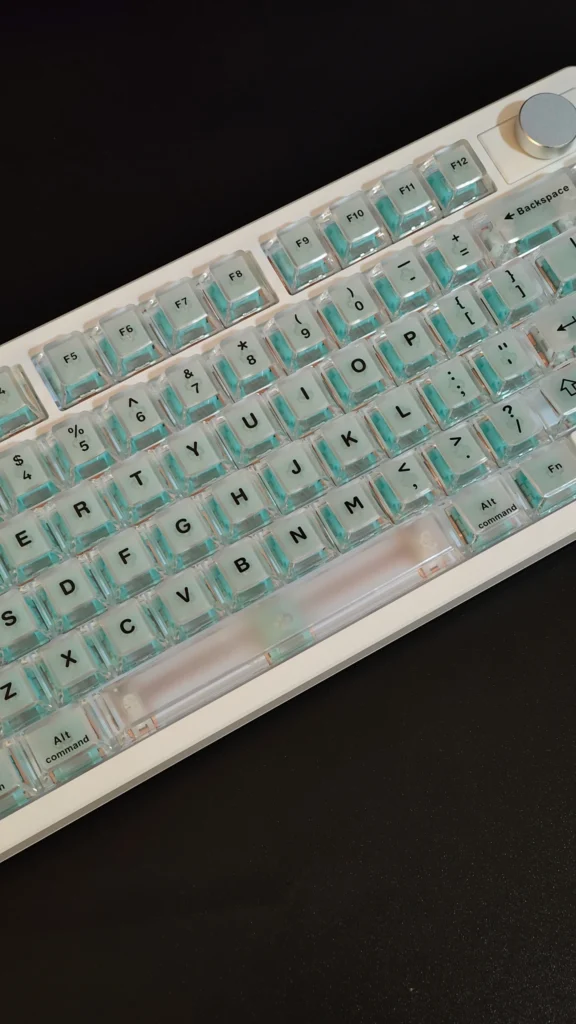
The HE75 V2 TMR supports up to 8,000Hz polling over both USB and 2.4GHz wireless. Bluetooth operates at 125Hz. EPOMAKER also specifies a 128KHz full-board scan rate. In our testing notes, the keyboard recorded approximately 0.585ms latency when wired and 0.961ms over wireless using the testing methodology available to us.
Those figures are extremely low, although real-world latency can vary depending on the test equipment, connection mode, PC configuration and other factors. More importantly, the HE75 V2 TMR felt responsive in actual games. We did not experience a noticeable difference between wired and 2.4GHz wireless during normal gameplay.
The 8,000Hz polling rate is therefore more relevant as part of the keyboard’s overall low-latency design than as a feature that every user will necessarily feel in everyday use.
EPOMAKER’s software provides access to the keyboard’s deeper configuration options. We can remap keys, create profiles, configure the function layer, adjust actuation points, configure Rapid Trigger, set dead zones, recalibrate the switches and customise the lighting.
The rotary knob can also be remapped, including its clockwise, counter-clockwise and press actions. Profile switching is particularly useful. We can create separate configurations for gaming, productivity or different games and move between them using keyboard shortcuts.
The software also provides advanced functions such as DKS, SOCD-style controls and Combo Burst. However, there is an important limitation to be aware of.
Some of the advanced key functions cannot be used simultaneously with Rapid Trigger. For example, enabling certain functions such as Snap Key/SOCD can disable Rapid Trigger. This creates a trade-off between using those advanced functions and retaining Rapid Trigger.
For users who prioritise competitive gaming performance, this is worth understanding before configuring the keyboard. Other magnetic and TMR keyboards allow some of these functions to coexist, so the limitation feels more restrictive than necessary. There are also some less polished aspects of the software interface. Configuration is generally straightforward, but the application can occasionally require extra steps before settings are applied correctly.
The firmware-level shortcut that disables Rapid Trigger is another point to watch. Because it can be triggered through a function-key combination, it is possible to disable Rapid Trigger without immediately realising that it has happened. The software may continue to show Rapid Trigger as enabled even though the keyboard’s shortcut has disabled it.
This is the biggest usability issue we encountered because Rapid Trigger is one of the main reasons to buy this keyboard. It is not a hardware failure, but it is something users should understand when configuring the board.
The HE75 V2 TMR supports three connection modes: USB-C wired, 2.4GHz wireless and Bluetooth. The 2.4GHz connection is the mode to use when gaming wirelessly because it supports the keyboard’s high polling rate. Bluetooth is better suited to general productivity and multi-device use.
The keyboard can also store multiple Bluetooth connections, making it easier to switch between devices. One limitation is that the web-based configuration software does not detect the keyboard when connected wirelessly in every situation. For deeper configuration, connecting the keyboard via USB is the safer option. That is not a major issue because most users will configure the keyboard occasionally rather than constantly.
The keyboard has a large 8,000mAh battery, split internally into two 4,000mAh cells according to EPOMAKER’s specifications. We did not exhaustively measure the battery from a full charge to empty under a controlled test, so we would avoid giving a precise runtime figure.
Actual endurance will depend heavily on RGB brightness, lighting effects, polling rate, wireless mode and usage patterns. The large capacity is nevertheless useful for anyone planning to use the keyboard wirelessly for extended periods. TMR’s power-efficiency advantages are also relevant here, although running at 8,000Hz continuously will naturally place greater demands on the battery than lower polling rates.
One practical point is that the keyboard can always be used wired, so battery life does not become a limitation when the board is used primarily at a desk.
The HE75 V2 TMR works well outside gaming. The 75% layout provides a good balance between desk space and functionality. We retain the arrow keys, function row and several navigation keys without the footprint of a full-size keyboard.
Users moving from a full-size board may need some time to adjust, particularly around the compact navigation area, but the layout quickly becomes familiar. The smooth switches and controlled acoustics also make the keyboard comfortable for extended typing sessions.
The ability to create different profiles is useful here. A gaming profile can use aggressive actuation and Rapid Trigger settings, while a typing profile can use deeper actuation points to reduce accidental inputs. That flexibility is one of the main reasons the HE75 V2 TMR works as an all-round keyboard rather than being limited to competitive gaming.
The EPOMAKER HE75 V2 TMR is a well-rounded magnetic gaming keyboard that does considerably more than chase headline specifications. The TMR sensing system, adjustable actuation, Rapid Trigger and 8,000Hz polling provide the performance expected from a modern competitive gaming keyboard. More importantly, the keyboard feels responsive and consistent in actual use.
The typing experience is another strength. The Creamy Jade switches are smooth, the stabilisers are well controlled and the gasket-mounted construction with five layers of sound treatment produces a pleasant acoustic profile. The hybrid PCB is arguably one of the most useful features. Being able to install both magnetic and conventional 3/5-pin mechanical switches gives the HE75 V2 TMR more flexibility than many magnetic keyboards.
Wireless performance is also strong. The 2.4GHz connection feels responsive enough for gaming, while Bluetooth provides a practical option for laptops, tablets and other devices.
There are some caveats. The plastic construction is understandable at this price but does not provide the rigidity or material feel of a premium aluminium keyboard. The software also needs some refinement, and the interaction between Rapid Trigger and certain advanced gaming features is unnecessarily restrictive.
The Rapid Trigger shortcut is the bigger concern. Users who rely on Rapid Trigger should make sure it has not been disabled through the keyboard’s function-key combination before assuming that their configured profile is behaving incorrectly.
At around $129, the EPOMAKER HE75 V2 TMR sits in a competitive segment where 8,000Hz polling and Rapid Trigger are no longer unusual features. Its value comes from putting those features together with good acoustics, wireless connectivity, a large battery and unusually broad switch compatibility.
For gamers who want a 75% magnetic keyboard that can also function as an everyday typing board, the HE75 V2 TMR offers a strong combination of performance and flexibility. Its software quirks prevent it from being a completely frictionless experience, but the underlying hardware and typing experience are impressive for the price.
Yes. The HE75 V2 TMR combines adjustable magnetic actuation, Rapid Trigger and up to 8,000Hz polling over USB and 2.4GHz wireless. In our testing, it felt highly responsive during gaming, including when used wirelessly.
TMR stands for tunnelling magnetoresistance. It is a magnetic sensing technology used to detect changes in a switch’s position. The HE75 V2 TMR uses this technology for adjustable actuation and Rapid Trigger functionality.
Yes. Unlike the standard HE75 V2, the TMR version uses a hybrid PCB that supports compatible magnetic switches as well as 3-pin and 5-pin mechanical switches.
Yes. It supports 2.4GHz wireless at up to 8,000Hz polling, making it suitable for gaming without a USB cable. Bluetooth is also available for general wireless use.
The keyboard has an 8,000mAh battery. Actual battery life depends on the connection mode, polling rate, RGB brightness and usage pattern.
There are limitations. Some advanced functions, including Snap Key/SOCD-style features, can disable Rapid Trigger. Users who prioritise Rapid Trigger should check their configuration before gaming.
Yes. The hybrid PCB supports compatible magnetic switches and standard 3-pin and 5-pin mechanical switches.
The keyboard supports up to 8,000Hz polling over USB and 2.4GHz wireless. Bluetooth operates at 125Hz. EPOMAKER also lists a 128KHz full-board scan rate.
The HE75 V2 TMR is worth considering if you want a compact 75% keyboard with TMR magnetic sensing, adjustable actuation, Rapid Trigger, wireless connectivity and support for both magnetic and mechanical switches. Its software and advanced-feature limitations should be considered before buying.
Also Read: Epomaker HE75 V2 Review

We review the SteelSeries Apex Pro TKL Gen 3, featuring OmniPoint 3.0 Hall Effect switches, adjustable actuation, Rapid Trigger, OLED display and RGB lighting.
Our EPOMAKER TH65 review examines its 65% layout, Creamy Jade switches, gasket mount, 8000mAh battery, wireless connectivity, gaming performance, and value.
Our KiiBOOM Phantom81 V4 review looks at its design, build quality, switches, RGB lighting, gaming performance, connectivity, battery life and value.
 Joshua James
 Emil Aloysius